Flex 5000

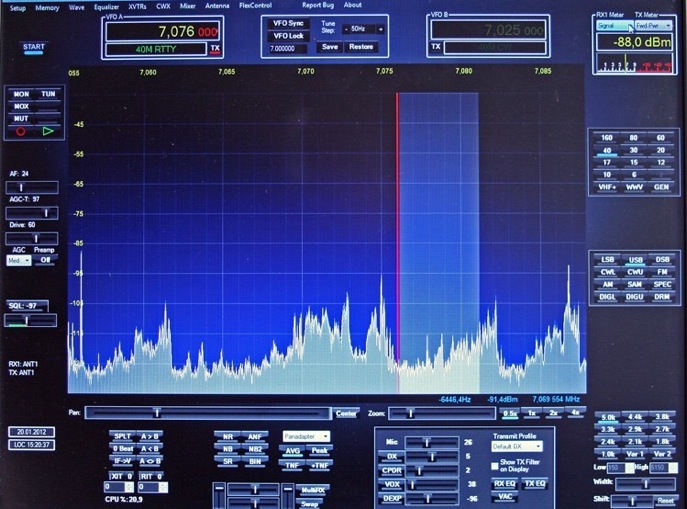
I bought this rig in 2010 and I‘m more than 100% convinced of it. I‘ve used it for more than 1000 QSOs since, most of them in CW, lots in SSB, JT65A (QRP) and in the 2011 CQWW-RTTY contest on 80 m in 2011 with a lot of fun.
The receiver of the Flex 5000 is without any doubt the best I‘ve ever worked with. It outperforms any competitors I know including professional ones of several times the price. The concepts of filtering - just improved in the latest Power-SDR version - and the flexibility are a joy to work with - especially on CW. During the 2011 CW-contest on 160 m I was abled to test it und the „hard“ Central-European circumstances and and I could work much more DX-stations than ever before. The possibility to reduce the bandwith to 100 Hz without influencing the audio-quality of the signal was of great use here. The new notch filter in the latest software-version improves also the SSB-quality remarkably - especially if someone is tuning on the frequency you are listening to.
The bandscope is of extreme use, from another universe than that of my old (and sold) ICOM 756 PRO.
I‘ve bought the „naked“ model without 2nd receiver (I dont use it, also not during contests) and without antenna-tuner. The feeding lines of most of my antennas are symmetric 600 Ohm wirelines, for which I have QRO-tuners if necessary.
One has to be careful in using sufficient computer power. I work with a up-to-date 64 bit machine and 4 GB RAM. It is essential, that the autostart doesn‘t contain too much nonsense (and this means nearly everything) and that the interrupts are configured correctly - preferably one interrupt only for firewire and nothing else. I‘m using between 10% and 20% of CPU-power depending whether there is other software for digital modes running in parallel. No drop-outs, no latency in CW - no one need knobs in the 21st century exept one likes them (take a look at my Heatkit transmitter)...
Ich arbeite seit 2010 mit dem Flexradio 5000 und bin zu 100% oder mehr von diesem Gerät überzeugt. Mittlerweile sind über 1000 QSOs, die meisten in CW, aber auch viele in SSB, JT65A (QRP) und in RTTY (CQWW-RTTY in 2011 auf 80 m) im Log.
Der Empfänger vom Flex 5000 ist mit weitem Abstand der beste, mit dem ich je gearbeitet habe. Er übertrifft auch professionelle Geräte, die ein Mehrfaches kosten. Die mit der letzten Version von Power-SDR noch einmal verbesserten Filtermöglichkeiten dürften in ihrer Flexibilität einmalig sein - vor allem in CW. Während des 160 m CW-Contest 2011 war es möglich, die im - wie in Mitteleuropa üblich - total „überbevölkteren“ Band zu testen. Vor allem die Möglichkeit, die Bandbreite ohne Audio-Einschränkungen bis auf 100 Hz zu verringern, hat QSOs, an die sonst gar nicht zu denken gewesen wäre, möglich gemacht. Das neue Notch-Filter verbessert den Empfang in SSB bemerkenswert - besonders, wenn irgendjemand auf der abgehörten Frequenz gerade abstimmt...
Die Bildschirmdarstellung mit dem Scope ist im Vergleich zu meinem alten IC 765 PRO aus einer anderen Welt.
Ich habe das einfache Modell ohne Zweitempfänger (hab ich noch nie vermisst) und ohne eingebauten Antennentuner. Einige meiner Antennen werden symmetrisch mit 600 Ohm Hühnerleitern gespeist, das wäre mit dem Tuner vom Flex nicht machbar.
Ein bisschen Sorgfalt sollte bei der Auswahl eines geeigneten Computers walten. Ich habe eine neue 64 Bit Maschine mit 4 GB RAM, was auch - nach meiner Erfahrung - erforderlich ist. Es ist ungemein wichtig, den Autostart von allem zu säubern, was da nicht hingehört (und das ist fast alles!) und dafür zu sorgen, dass am Interrupt für die Firewire-Schnittstelle nichts anderes läuft. Mein Rechner nutzt jetzt zwischen 10% und 20% der Prozessorleistung, je nachdem, ob noch Software für Digimodes parallel läuft. Es gibt keinerlei Probleme, auch keine Latenzen bei CW, von denen andere OMs manchmal berichtet haben. Bedienungsknöpfe sind heutzutage überflüssig, es sei denn, man findet sie schön (schaut mal auf meinen alten Heathkit-Sender) ...